 Call us now:

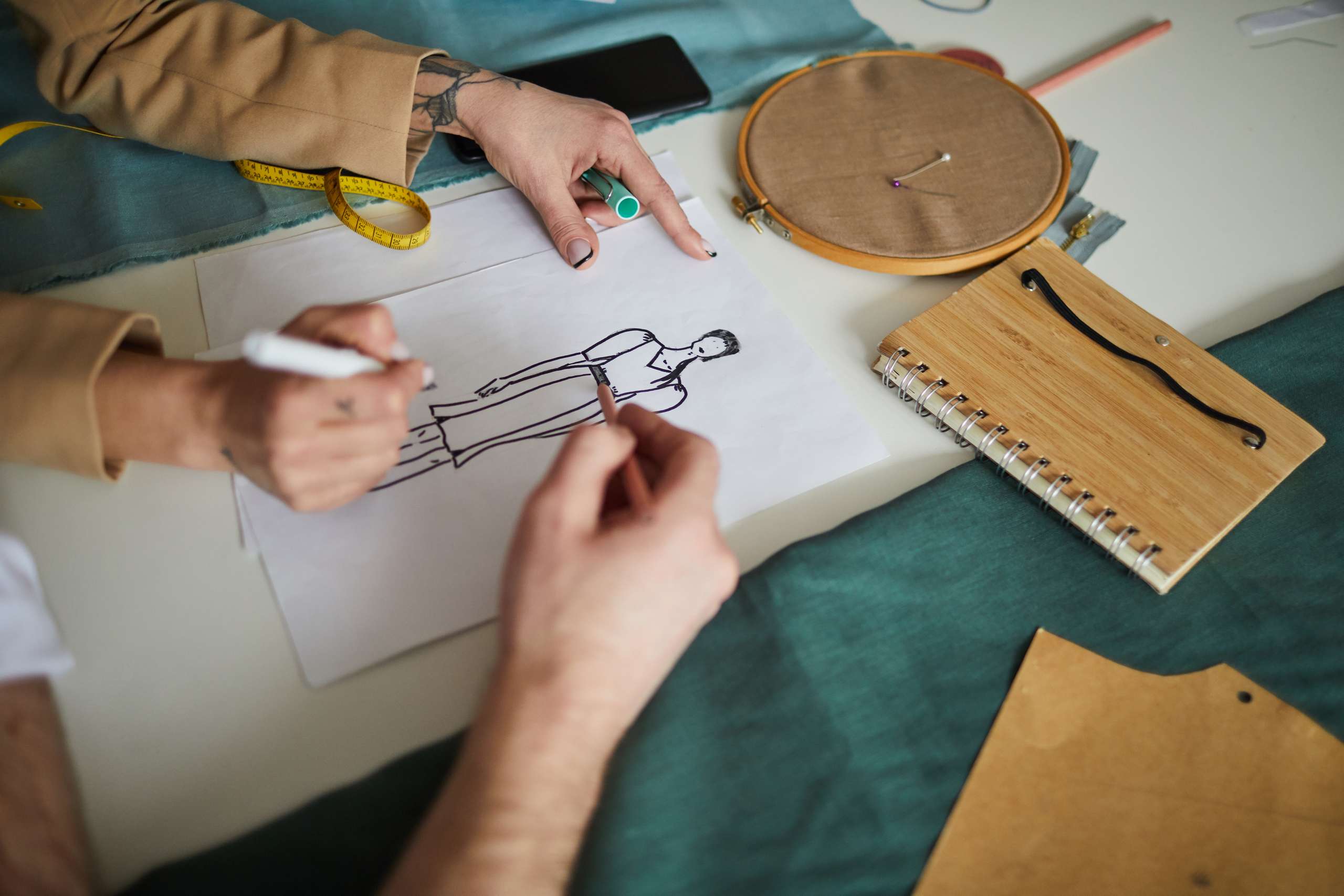
A simple sketch will usually look more like a paper doll than a dress on a real person. The line will be hesitant, the shape stiff, and the fabric flat. This will be because you’re sketching the outline before thinking about the way the fabric looks on a person. So instead of drawing a line, think of the weight of the fabric, and gravity pulling it down. The skirt would fall away from the waistband, the sleeves will crease as they bend at the elbow, and soft fabric will rumple where the tension is released. It can be helpful to just draw a basic outline of the body, and then superimpose the clothes on it, even if it’s just a stick figure. The result will be more lifelike than a dress hung in mid-air.
One of the biggest errors people make is to press down too soon. Once you have a heavy line, it will be hard to change proportions, or to establish movement. When fabric wraps over, or tucks under, a stiff line gives you a crease where you should have a rounded fold. Try starting with light lines and building them up. Use three or four light lines to build the volume of an object rather than trying to get it with one definitive line. If you see a line that is wrong, don’t erase it, but rather draw the correct line next to it. As you practice, your ability to judge the correctness of a line will improve. A rough start is not a mistake; it’s just an indication that you are searching.
Further, the type of fabric dictates the folds a sketch will have. A woolen dress has big drapery while a silk blouse has delicate waves. If you fail to make this separation all your clothes will look like they’re made of some sort of fantasy fabric. For each study, decide what type of fabric you’re drawing, and how it wrinkles. Take a scarf, a towel or a shirt and watch where the creases begin. When you draw them they will look like real folds instead of fancy outlines.
If you have less time, even 15 minutes of sketching can be useful. Start by tracing the gesture to loosen up your hand, then select one detail of a garment such as a sleeve, collar, or hem and redraw it in different positions. Finally, trace a few shadow lines under the creases to create volume. This short exercise practices visualization, line control, and three-dimensional thinking, all without rendering an entire drawing.
So if you’re struggling with a drawing and everything looks terrible, take a break and go observe the way clothes work in reality. Sometimes our hands just don’t remember this stuff, and when we come back to the drawing with our eyes refreshed, it takes only the slightest adjustments to suddenly see the clothes as living garments, rather than awkward outlines.